An Ghluaiseacht: Irish language activism in the Gaeltacht

Introduction: More Than a Language Revival
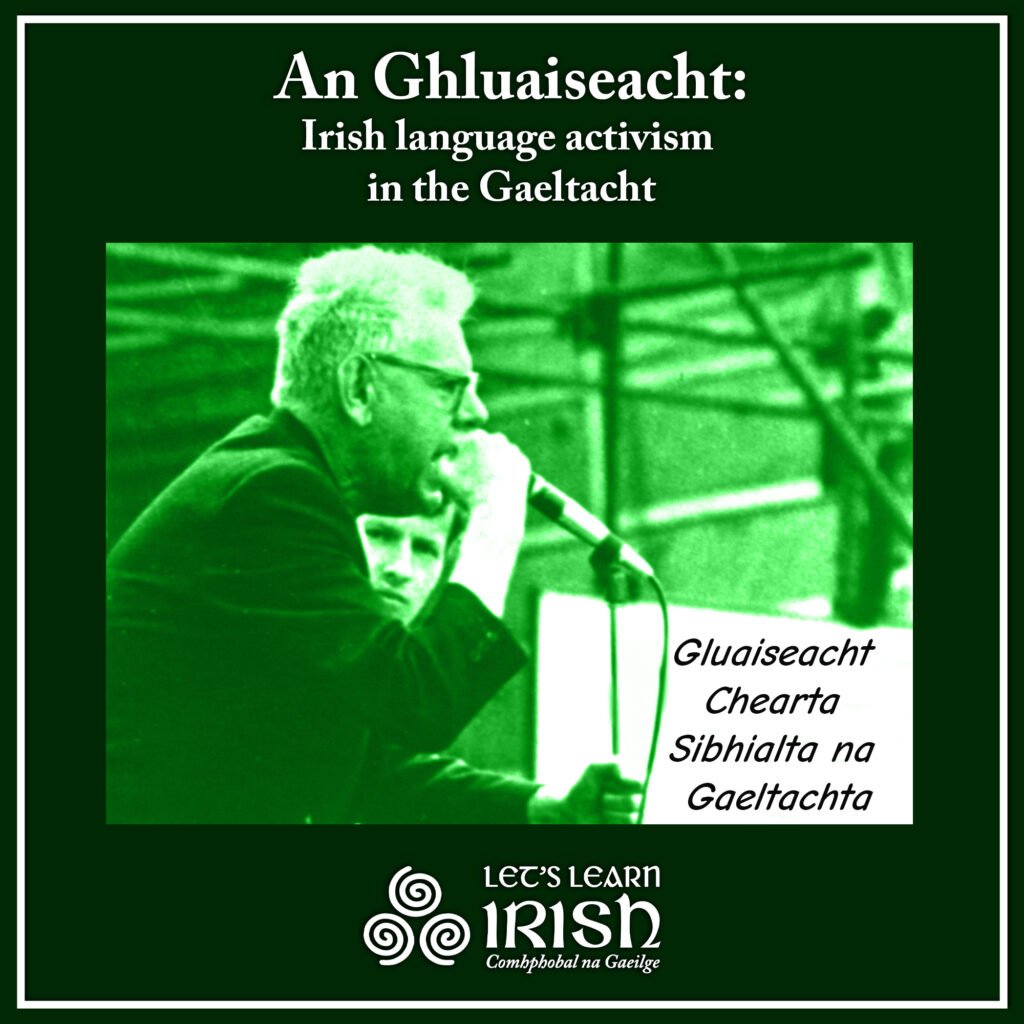
Gluaiseacht Chearta Sibhialta na Gaeltachta (The Gaeltacht Civil Rights Movement) was founded in Connemara in 1969. Its purpose was to highlight the decline of the Irish language and to campaign for greater rights for Irish speakers in the Gaeltacht. This was a dynamic, confrontational and deeply modern movement. It emerged from frustration with state neglect, economic marginalisation, and cultural invisibility, particularly in Gaeltacht areas. The movement forced Irish society to reconsider the place of language in public life and its repercussions are still felt today.
The Irish language movement of the 1960s was not simply about preserving a threatened language. Instead, it was a broad social and political movement—one that questioned who held power in Ireland, whose voices mattered, and what kind of country Ireland wanted to become.
From Cultural Ideal to Political Reality
Early Irish language activism was often rooted in cultural nationalism, shaped by organisations such as Conradh na Gaeilge and the ideals of the Gaelic Revival. However, cultural symbolism alone proved insufficient.
By the mid-twentieth century, Gaeltacht communities faced population decline, unemployment, and inadequate public services. Irish survived as a spoken language, but speakers increasingly felt abandoned by the state that claimed to value it. This gap between rhetoric and reality radicalised a new generation of activists. Language was no longer just heritage; it became a political issue tied directly to housing, education, broadcasting, and economic survival.

The Birth of a Grassroots Movement
Gluaiseacht Chearta Sibhialta na Gaeltachta drew inspiration from international civil rights struggles. Activists adopted direct action tactics – protests, occupations, and campaigns of non-cooperation – to demand concrete language rights. This activism was rooted in community organisation rather than elite leadership. Ordinary Gaeltacht residents, teachers, parents, and young people played central roles. Irish was used deliberately in meetings, protests, and public communications, asserting its legitimacy as a language of power rather than folklore. Crucially, the movement reframed Irish speakers not as cultural curiosities but as citizens demanding equality.
Media, Visibility and the Battle for Public Space
One of the most significant achievements of this civil rights movement was the transformation of Irish-language visibility in media and public life. Campaigns for broadcasting rights led directly to the establishment of Raidió na Gaeltachta, a landmark moment that validated Irish as a modern, everyday language.
Media access, in turn, altered public perceptions. Hearing Irish used to discuss news, politics, and contemporary life challenged stereotypes and strengthened community confidence. The movement understood that language survival depended not only on speakers, but on presence—on being heard, seen, and taken seriously. This struggle over visibility extended to signage, public services, and state institutions, embedding language rights into everyday interactions.
Conflict, Criticism and Internal Tensions
Admittedly, the Gaeltacht Civil Rights Movement was neither unified or uncomplicated. Internal disagreements over tactics, priorities and relationships with the state abounded. Some activists favoured negotiation and gradual reform, while others believed confrontation was necessary to force change.
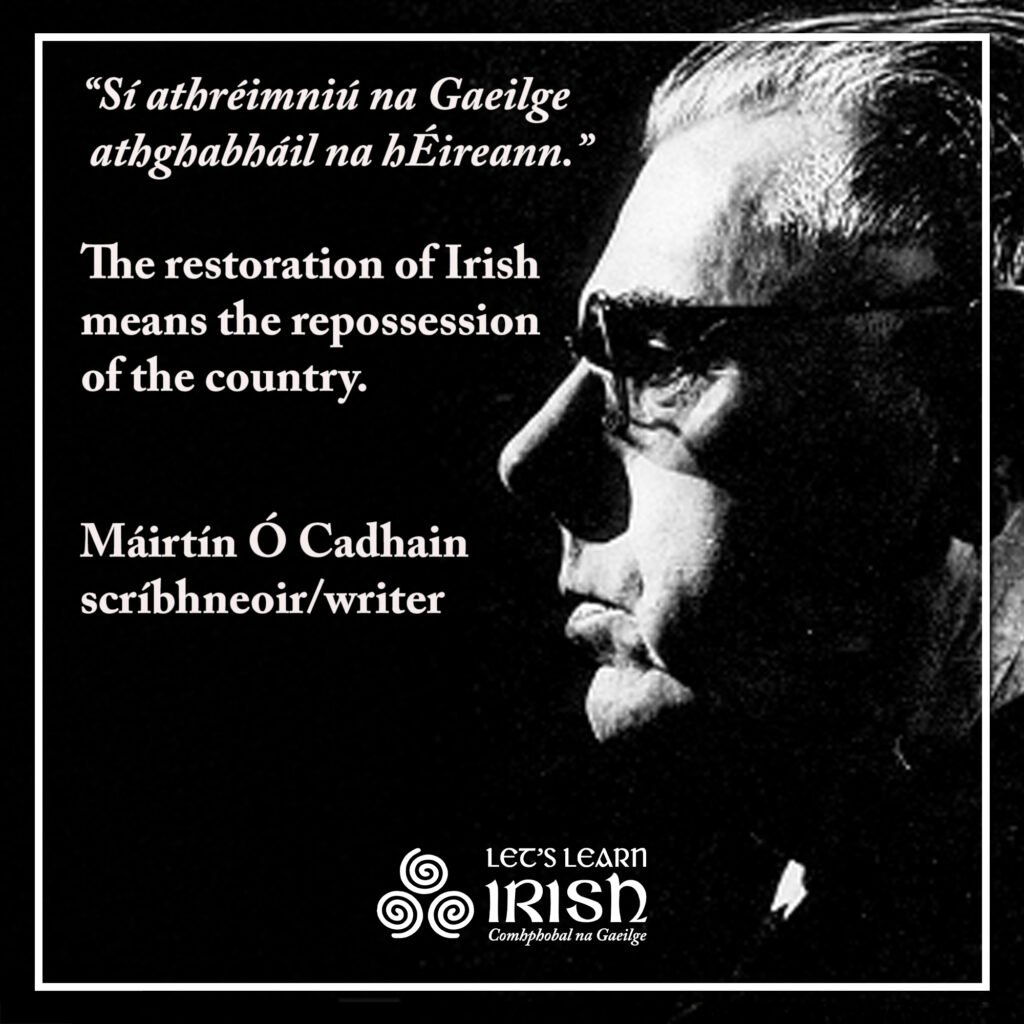
One such activist was the renowned writer Máirtín Ó Cadhain. He is recognised to have brought a political clarity and uncompromising advocacy to the campaign. Ó Cadhain supported direct action to challenge state neglect of Gaeltacht communities, insisting that Irish speakers were entitled to full citizenship rights. His writings and public interventions helped reframe the language struggle as a civil rights issue, inspiring activists to link linguistic revival with economic equality, education, and democratic participation rather than cultural nostalgia.
The movement also faced criticism from wider Irish society. Activists were sometimes portrayed as disruptive, unrealistic, or parochial. Such resistance was likely the result of deeper discomfort with linguistic equality and decentralised power. These tensions, rather than weakening the movement, often sharpened its political clarity.
Over time, sustained pressure produced results. Government policy began to shift, albeit unevenly. Irish-language education expanded, broadcasting services improved, and Gaeltacht development policies were re-examined. Progress was won through persistence rather than goodwill, and official recognition often lagged behind community demands. In the end, the movement fundamentally altered the relationship between Irish speakers and the state.
Legacy and Contemporary Relevance
Gluaiseacht Chearta Sibhialta na Gaeltachta succeeded in improving social, economic and cultural rights for native-speakers living in Gaeltacht areas. The movement inspired later campaigns, from urban Irish-medium education to contemporary language activism in Northern Ireland. Today’s online learning communities, grassroots initiatives, and renewed interest in Irish among younger generations all carry echoes of earlier struggles. The insistence on community ownership, everyday usage, and linguistic confidence can be traced directly back to these activists.
The core insight of Gluaiseacht Chearta Sibhialta na Gaeltachta was that language thrives where people feel empowered to use it, an insight as relevant as ever today. It was not simply about saving words, but about reshaping relationships between citizens, communities and the state. We are reminded that language movements succeed not through sentimentality, but through organisation, confidence, and collective action. Irish survived – and continues to grow – not because it was preserved in theory, but because people fought to live through it.
Related Links:
- Documentary episode from RTÉ Raidió na Gaeltachta.
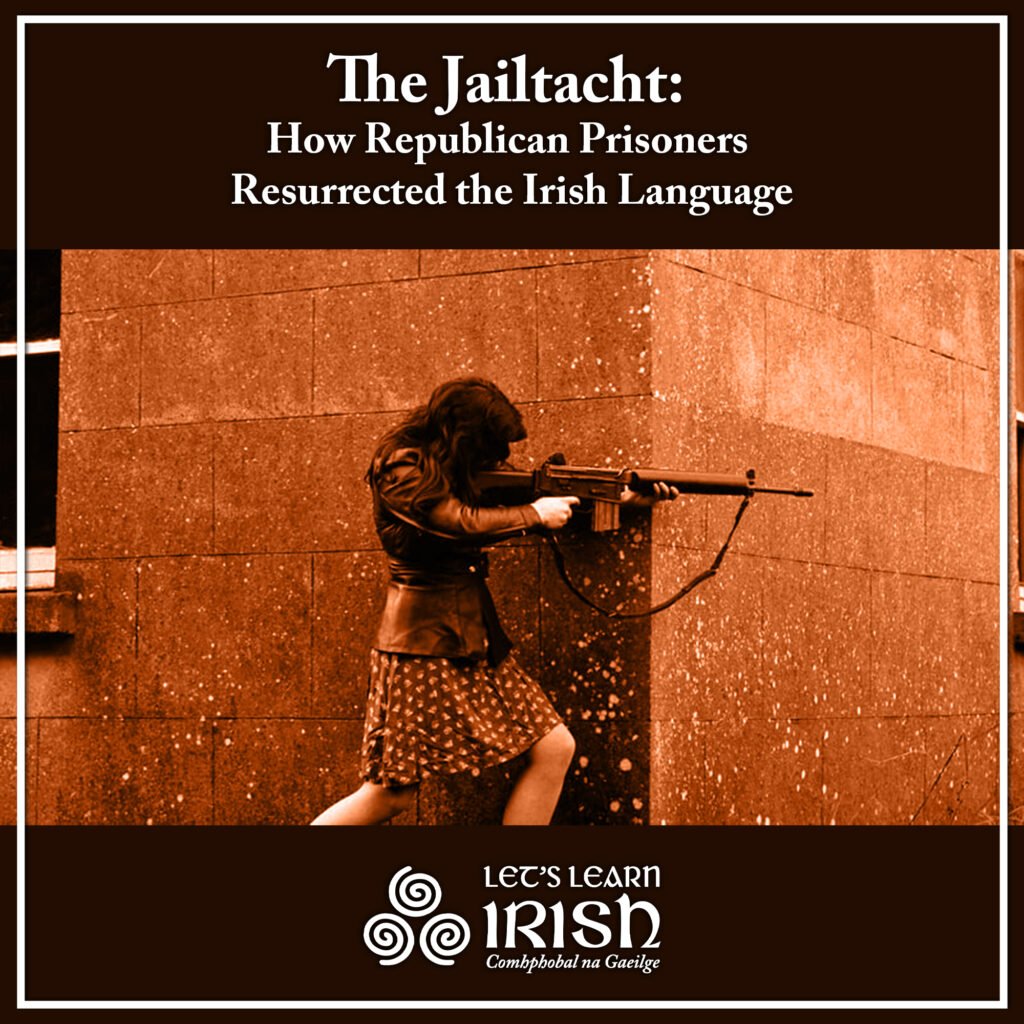
- The Jailtacht: How Republican Prisoners Resurrected the Irish Language.
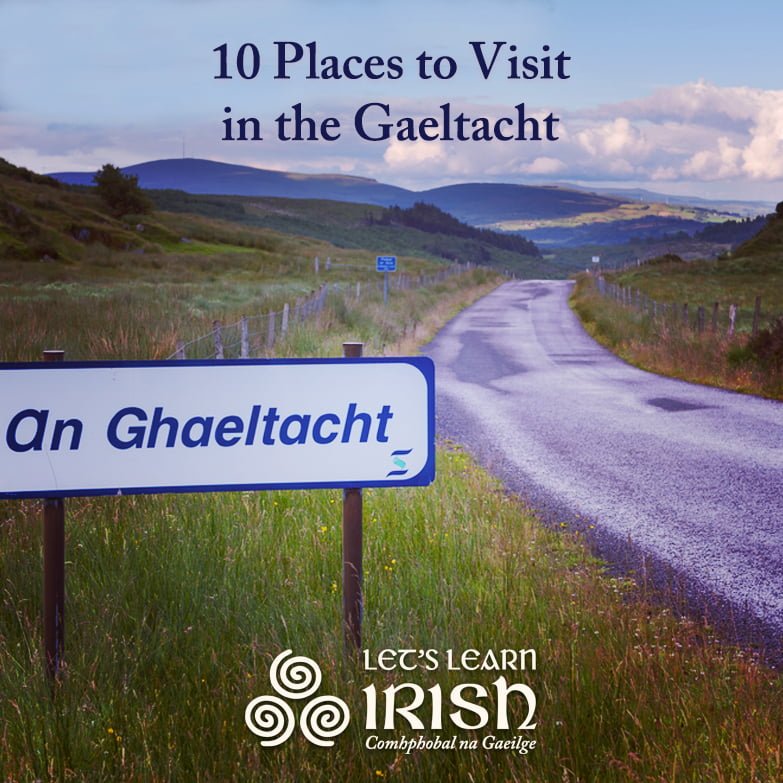
- 10 Places to Visit in the Gaeltacht.
- The Rise of Kneecap
Further Reading:
- Mac Con Iomaire, R. (2024) An Ghluaiseacht: Scéal Chearta Sibhialta na Gaeltachta. Baile Átha Cliath: Cló Iar-Chonnacht.
- Mac Giolla Chríost, D. (2012) Jailtacht: The Irish Language, Symbolic Power and Political Violence in Northern Ireland, 1972–2008. Cardiff: University of Wales Press.
- Nic Craith, M. (2003) Culture and Identity Politics in Northern Ireland. London: Palgrave Macmillan.
Bígí páirteach!
Join the online Irish community at LetsLearnIrish.com.
Follow on social media @LetsLearnIrish.