Frantz Fanon: Language and the Ongoing Struggle for Cultural Liberation

Introduction: Language as a Battleground
Frantz Fanon, psychiatrist, philosopher, and revolutionary, is one of the most influential voices on colonialism and identity today. He was born on 20 July 1925 in Fort-de-France, Martinique, which was then part of the French colonial empire, and was educated at the University of Lyon. Though widely cited for his writings on violence, racism, liberation and decolonisation, Fanon also placed language at the centre of the colonial encounter. For Fanon, language is not neutral; it is a terrain on which cultural domination and resistance unfold. In Black Skin, White Masks, he writes:
“To speak means to be in a position to use a certain syntax, to grasp the morphology of this or that language, but it means above all to assume a culture, to support the weight of a civilization.”
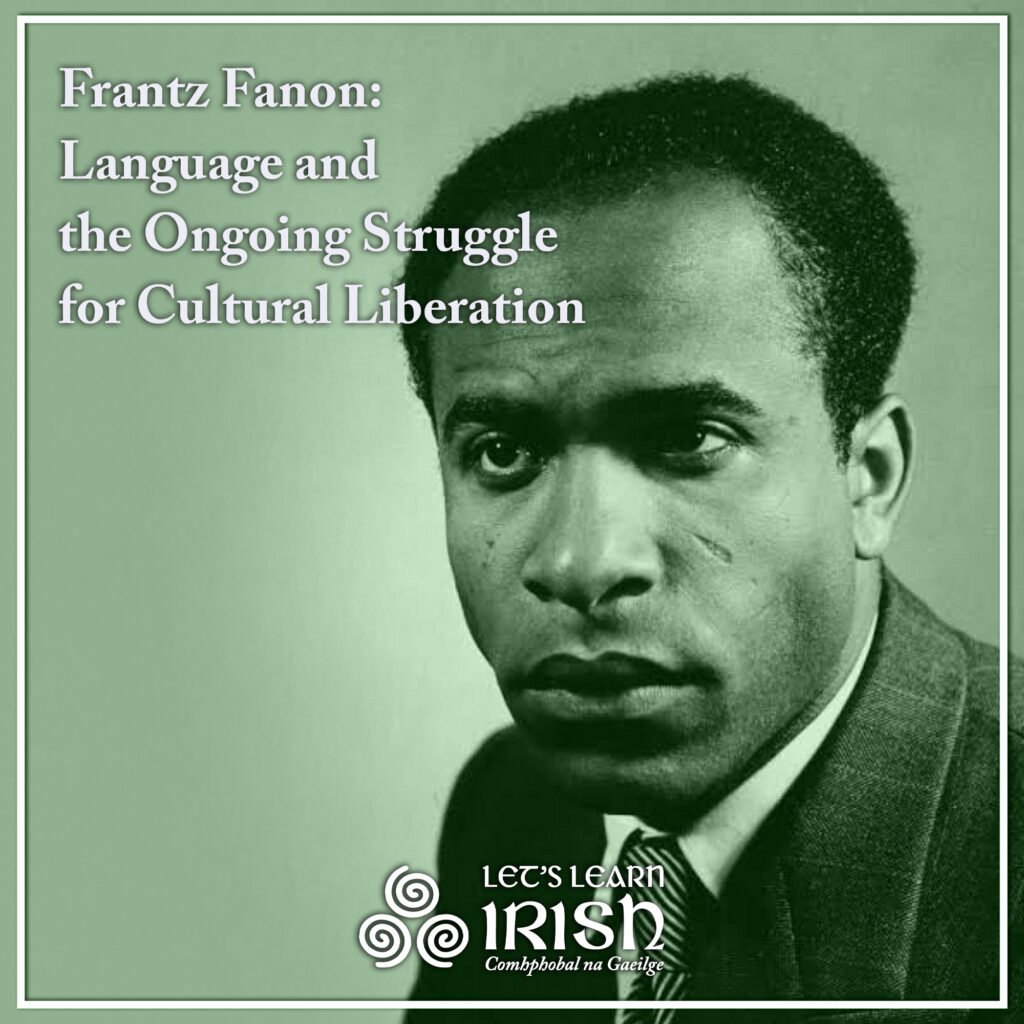
This idea forms the foundation of Fanon’s linguistic theory: language is not only about communication but about belonging, power and identity. When a colonised person adopts the coloniser’s language, they can also absorb its worldview and value system – sometimes at the expense of their own.
Ireland, with its long history of linguistic suppression and its dynamic modern revival movement, exemplifies many of Fanon’s arguments. Today’s surge in online Irish-language learning reveals that linguistic decolonisation is not a historical event but an ongoing cultural project.
Fanon on Language, Culture and Power
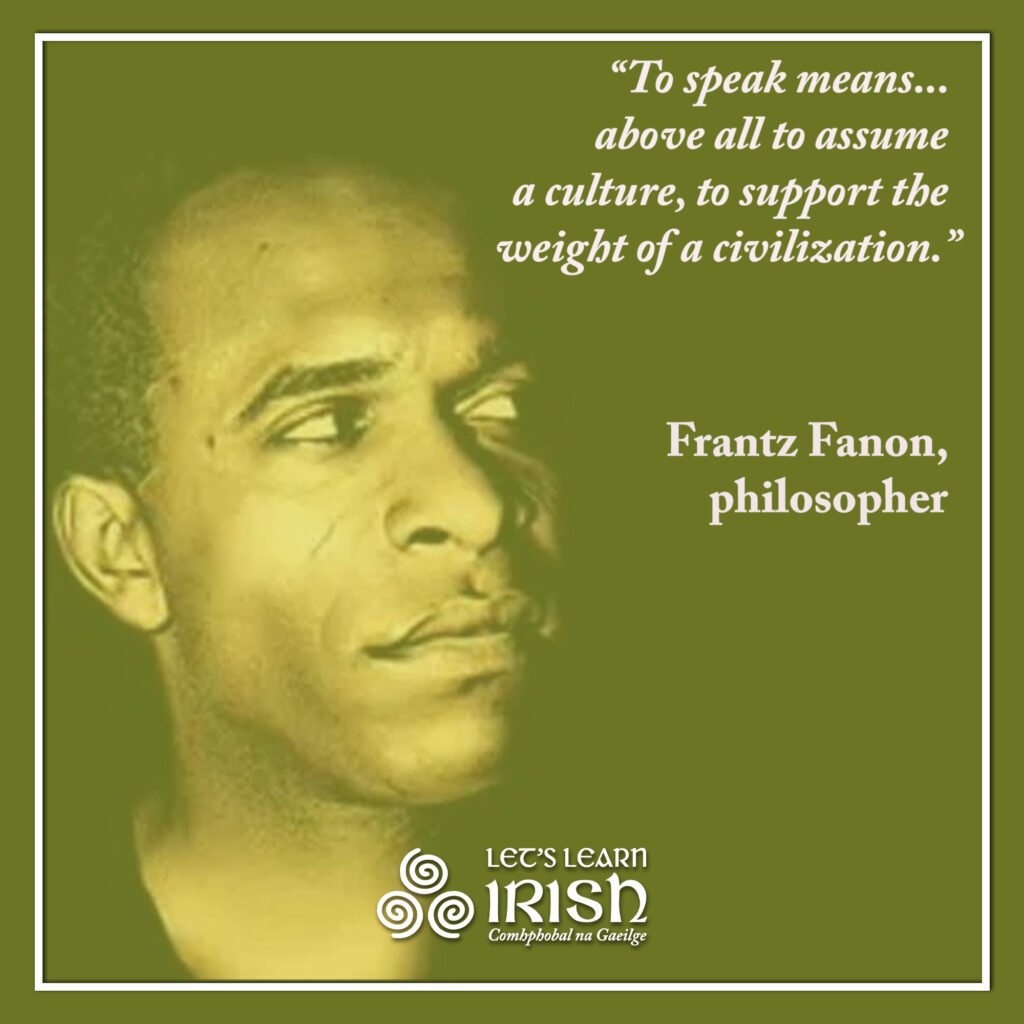
In Fanon’s analysis, colonialism does not merely impose foreign rule, it reshapes the psyche of the colonised. Language becomes one of the most potent instruments of this transformation. He argues that speaking the coloniser’s language is often linked to “aspiration,” or a desire to access the social and cultural privileges associated with that language. His famous line, “The Negro of the Antilles will be proportionately whiter… in direct ratio to his mastery of the French language”, articulates a psychological dynamic familiar in colonised societies across the world.
The coloniser’s language is constructed as the gateway to intelligence, prestige and legitimacy. Meanwhile, the native language is often dismissed as backward, emotional, primitive or unsuitable for modern life. This creates what Fanon calls “a zone of occult instability” within the self, where linguistic assimilation becomes both a survival strategy and a source of alienation. Nonetheless, Fanon is not fatalistic. He argues that reclaiming one’s own language – or remaking it – can be a crucial act of anticolonial resistance. In ‘The Wretched of the Earth’, his seminal book written shortly before his death in 1961, he emphasises the need to restore cultural agency:
“A national culture is not a folklore…but the whole body of efforts made by a people in the sphere of thought to describe, justify, and praise the action through which they created themselves.”
Ireland: Colonialism and Cultural Survival
Ireland’s linguistic story reflects many patterns Fanon identified in the French Caribbean and North Africa. Under British colonisation, the Irish language experienced sustained suppression, especially from the 18th century onward. English became the language of schooling, economics, administration, and social mobility. In this period, Irish was increasingly associated with poverty, backwardness, or resistance. English became the “proper” language of advancement, mirroring Fanon’s analysis that colonised subjects often internalise the coloniser’s view of linguistic hierarchy.
Generations of Irish families, facing material hardship and state pressure, shifted from Irish to English to secure economic survival for their children. Fanon would not interpret this purely as abandonment but as a coerced adaptation to colonial power structures.
Language as Self-Determination in Ireland
Fanon argued that reclaiming cultural practices, including language, is essential for psychological decolonisation. In Ireland, cultural revival served as a key marker of political autonomy and national rebirth. The 19th-century Gaelic Revival, the founding of the GAA, and the political writings of Douglas Hyde, Pádraig Pearse, and Máirtín Ó Cadhain exemplify a Fanonian project: reclaiming the language as a symbol of cultural freedom. Pearse’s statement, “Tír gan teanga, tír gan anam” (A country without a language is a country without a soul) neatly encapsulates the arguments Fanon would espouse years later regarding the inseparability of culture and self-determination.
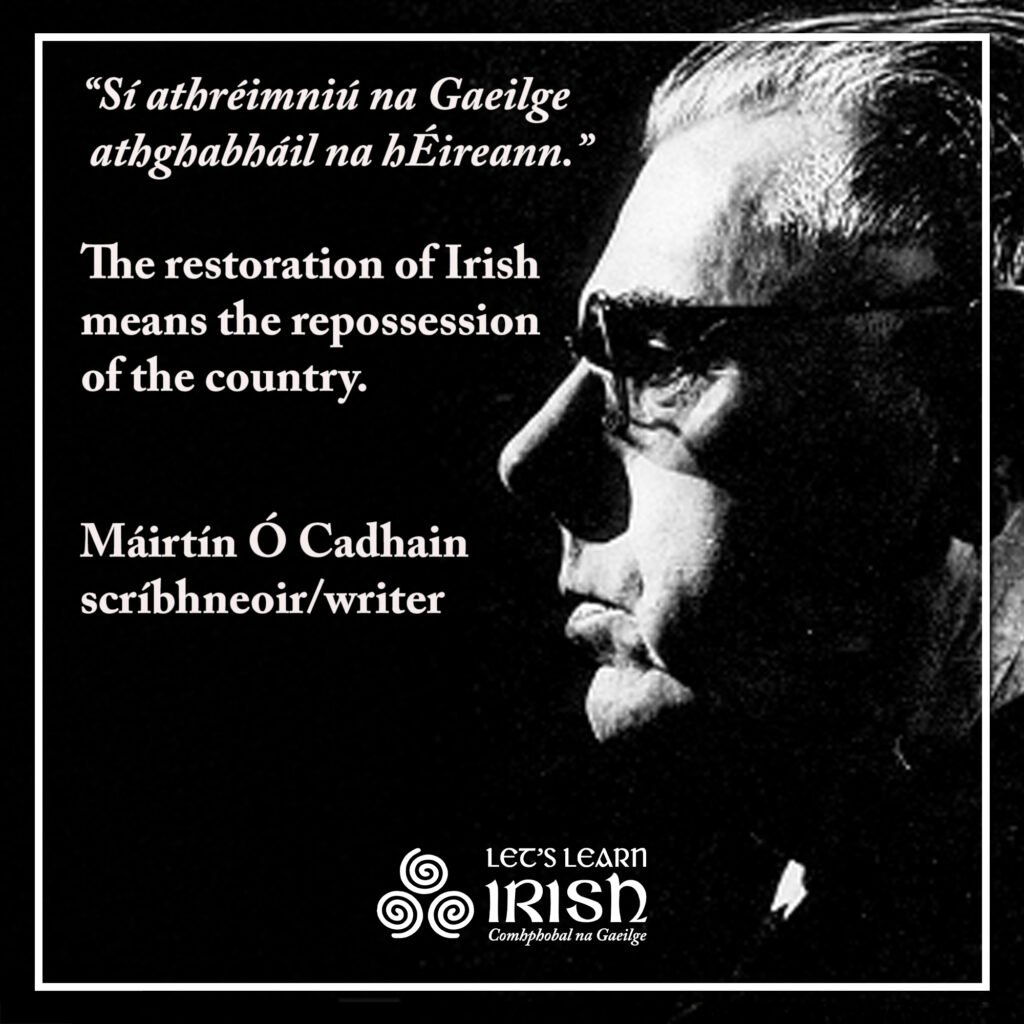
Gluaiseacht Chearta Sibhialta na Gaeltachta (The Gaeltacht Civil Rights Movement), began in Connemara in 1969. This was a local movement for economic, social and cultural rights for Irish speakers, demanding services, broadcasting and political representation. As Máirtín Ó Cadhain, the writer and political activist asserted, “Sí athréimniú na Gaelige athghabháil na hÉireann” – the restoration of Irish means the repossession of Ireland. This grassroots campaign ultimately increased Irish-language broadcasting, normalised Irish in public discourse, influenced the creation of Raidió na Gaeltachta, expanded Irish-language journalism, and made Irish-speaking communities visible as modern, politically active citizens rather than marginal, rural relics.
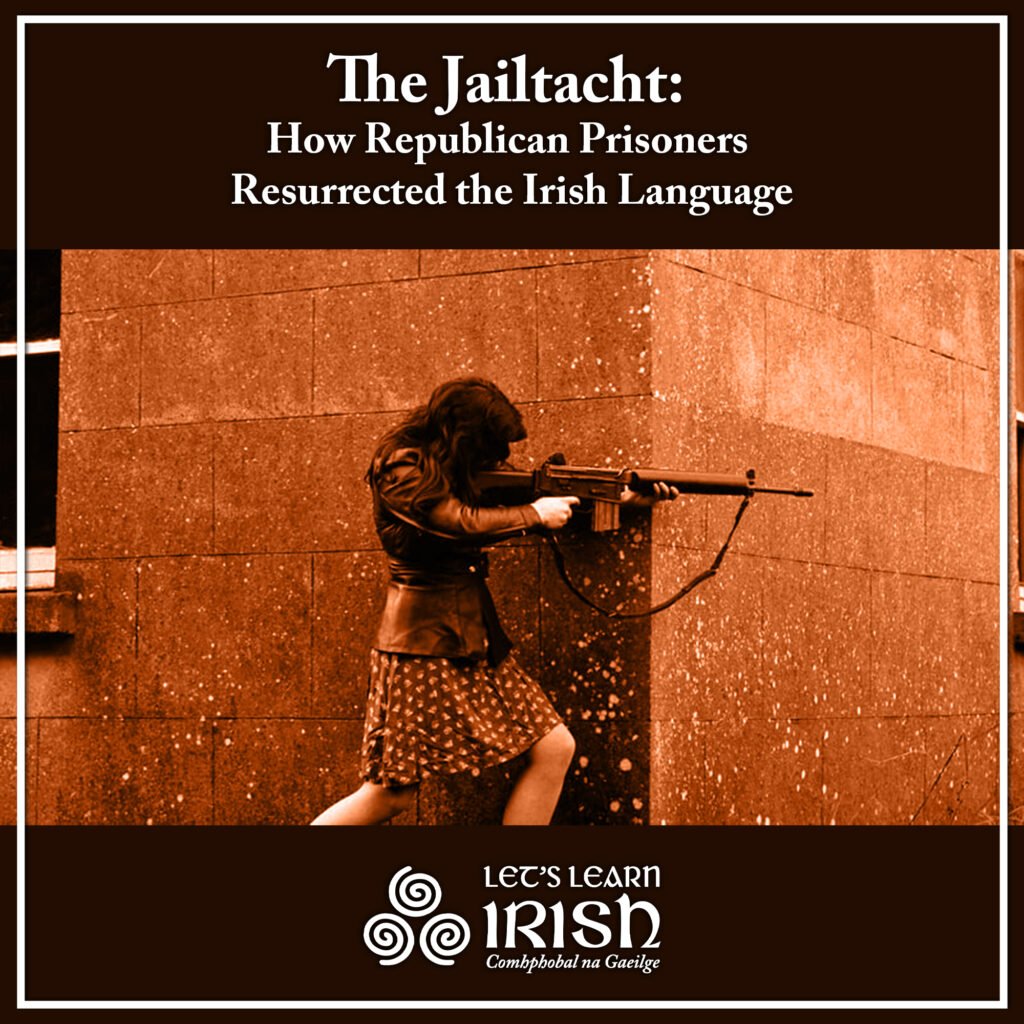
The Irish language also became a potent symbol of resistance, especially in republican communities. The use of Irish in Long Kesh and the H-Blocks during the 1970s–1980s, where prisoners created “Jailtacht” Irish-speaking wings, echoes Fanon’s notion of oppressed groups generating new cultural meaning under conditions of domination. Fanon recognised this exact dynamic:
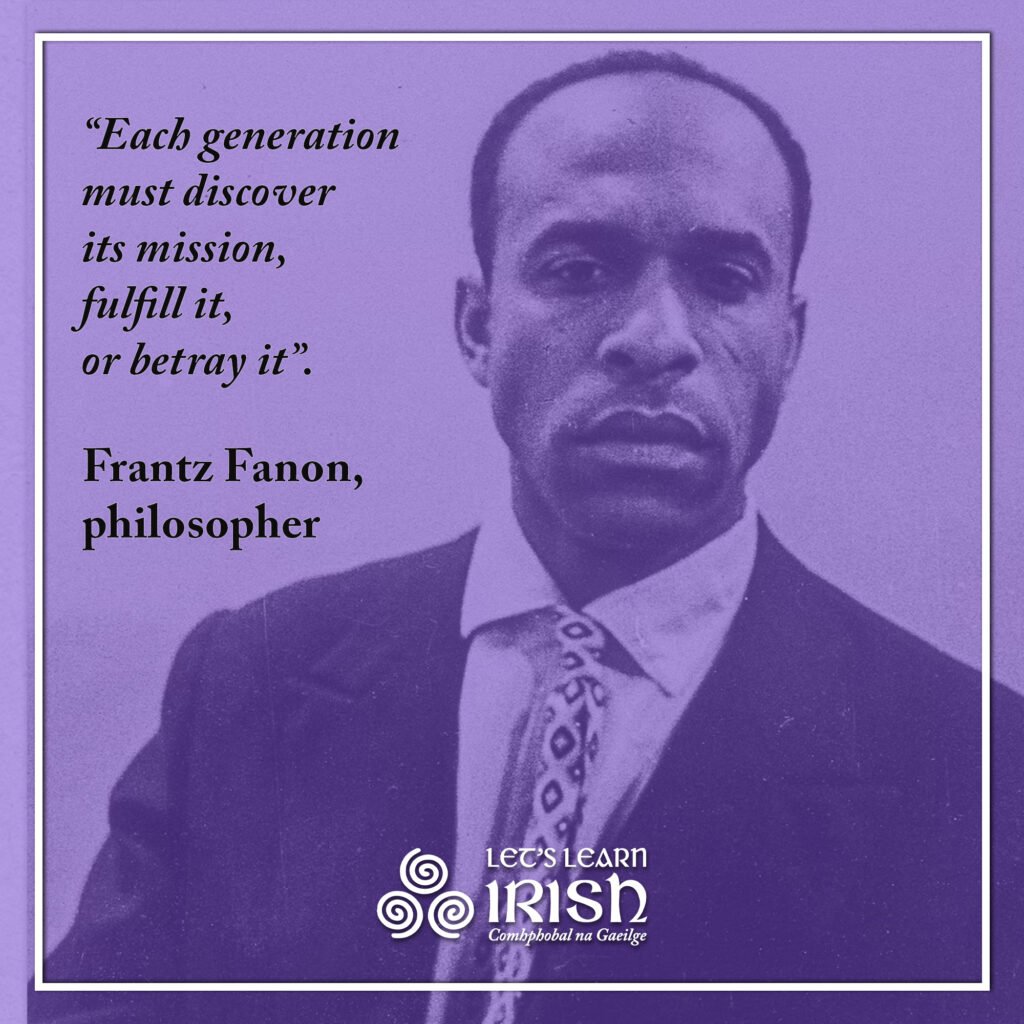
“Each generation must discover its mission, fulfill it, or betray it.”
Reviving Irish was not simply about vocabulary – it was about reclaiming cultural agency, resisting historical erasure and asserting a non-colonial identity. Fanon argued that cultural reclamation was essential to genuine decolonisation. In ‘The Wretched of the Earth’, he wrote that national culture is created through struggle, not nostalgia. Reclaiming Irish became a way of rejecting colonial hierarchies and asserting cultural self-determination. The language was no longer just a means of communication – it became a symbol of resistance, dignity, and identity.
Online Irish Learning: Digital Decolonisation
Fanon’s ideas illuminate the motivations behind today’s surge in online Irish-language learning, facilitated by platforms such as Duolingo, TikTok, YouTube and online communities. Many learners explicitly use Fanonian language of “reclaiming,” “reviving,” or “unlearning colonial narratives”. This reflects Fanon’s belief that cultural emancipation continues long after political independence. Today’s online Irish-language revival represents a new phase of decolonisation, driven primarily by:
- Heritage reclamation (“My grandparents had the language; I want it back”).
- Resistance to cultural homogenisation in a global Anglophone world.
- Political consciousness (“decolonising my mind,” a phrase now common among learners).
- Diaspora reconnection among Irish communities abroad.
Digital spaces democratise access to Irish in a way unthinkable in earlier periods, allowing people to reclaim Irish on their own terms, free from earlier associations of compulsion or shame. Many learners attending online classes, weekly comhrá sessions, workshops, watching Irish media or listening to podcasts are reconnecting with heritage, resisting cultural homogenisation and undoing historical erasure. Irish learners, whether in Dublin or Washington DC, Melbourne or Turkey, participate in a global project of linguistic self-determination rooted in Fanon’s legacy. This aligns with Fanon’s view that liberation must be collective, not confined to an educated elite.
Conclusion: Fanon’s Enduring Message
Frantz Fanon helps us see Ireland not as an exception, but as part of a global pattern of colonial language suppression and cultural resistance. He showed that language is a site of both oppression and liberation. Irish history demonstrates the destructive power of colonial linguistic policies, but also the resilience and creativity of a people committed to cultural revival. Fanon’s insights reveal why language remains politically and emotionally charged in Ireland, and why revival efforts, especially online, carry such symbolic weight.
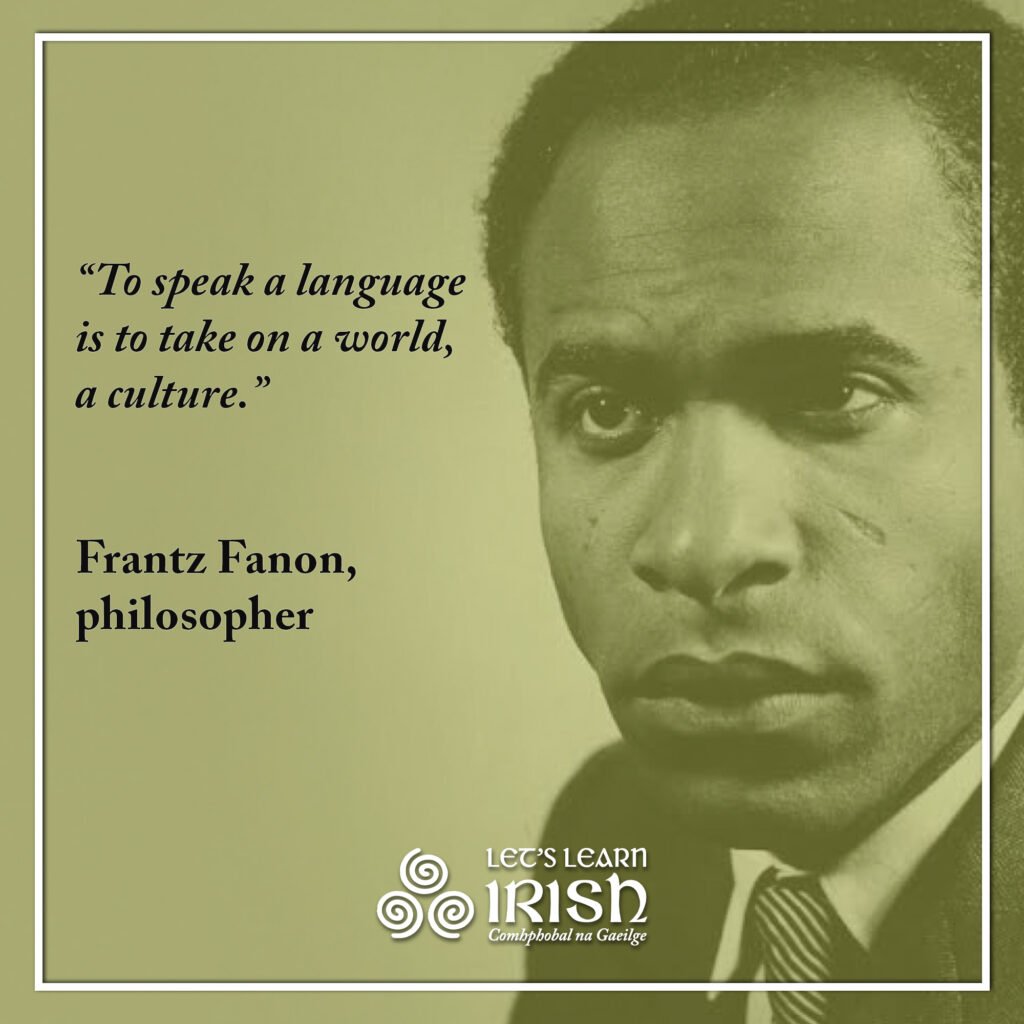
Today’s online Irish-learning community proves that language decolonisation is ongoing, dynamic, and global. As Fanon reminds us:
“To speak a language is to take on a world, a culture.”
By learning and speaking Irish, people today, at home and across the diaspora, continue to reshape that world, asserting dignity, identity, and cultural sovereignty.
Related Articles:
- The Process of Decolonization
- An Gorta Mór and the Irish Language.
- Decolonize Your Hearts!
- Super-Colonized Irish Syndrome.
- The Sapir-Whorf Hypothesis and ‘An Bata Scóir’.
Publications:
- Fanon, F. (1952) Black Skin, White Masks. Paris: Éditions du Seuil.
- Fanon, F. (1961) The Wretched of the Earth. Paris: Éditions Maspero.
- Ngũgĩ wa Thiong’o (1986) Decolonising the Mind: The Politics of Language in African Literature. London: James Currey.
- Kiberd, D. (1995) Inventing Ireland: The Literature of the Modern Nation. London: Jonathan Cape.
- Nic Craith, M. (2003) Language, Identity and Cultural Nationalism in Contemporary Ireland. Basingstoke: Palgrave Macmillan.
Bígí páirteach!
Join the online Irish community at LetsLearnIrish.com.
Follow on social media @LetsLearnIrish.