Count from 20-100 in Irish

Following on from counting 1-10 and counting 11-20we now present a video teaching the numbers 20-100 in Irish.

How to count from 20-100 in Irish

Now that we’ve learned to count from 1-20, we can start going further. It is easiest to start by understanding the base numbers before adding on the extras. In Irish, “twenty, thirty, fourty, fifty, sixty, seventy, eighty, ninety, a hundred” are “fiche, tríocha, daichead, caoga, seasca, seachtó, ochtó, nócha, céad”. 

Now that you have a basic understanding of those numbers, you can further your knowledge of counting in higher numbers by learning how to say “twenty-one, twenty-two” and so on. For example, “twenty-one” in Irish would be “fiche a haon” while “thirty-five” would be “tríocha a cúig”. So, as you can see, it is not that difficult once you begin to see the patterns and understand the occasional exceptions.

Watch the video to practice your pronunciation of these numbers and further evolve your Gaeilge!

Samplaí Eile / Other Examples:

– Uimhir seachtó = Number 70.

– Roinn an toradh ar chéad = Divide the result by 100.

– Cén uimhir a thagann roimh nócha? = What number comes before ninety?

– Caoga agus caoga, sin céad = Fifty and fifty is one hundred.

– Ochtó faoin gcéad = Eighty percent.

Bígí páirteach!
Join the online Irish community at LetsLearnIrish.com.
Follow on social media @LetsLearnIrish.
Related Articles

20 of the Best Irish Language Films

Irish language films are experiencing something of a renaissance. With more films being made every decade and with greater budgets to work with, Gaeilge is finding its way to the screen with increasing fervor. The last few years have seen groundbreaking milestones achieved, from the 2022 movie An Cailín Ciúin (The Quiet Girl) becoming the first film in Irish to be awarded an Oscar nomination, to the breakout success of Kneecap and how it helped bring attention to the Irish language.

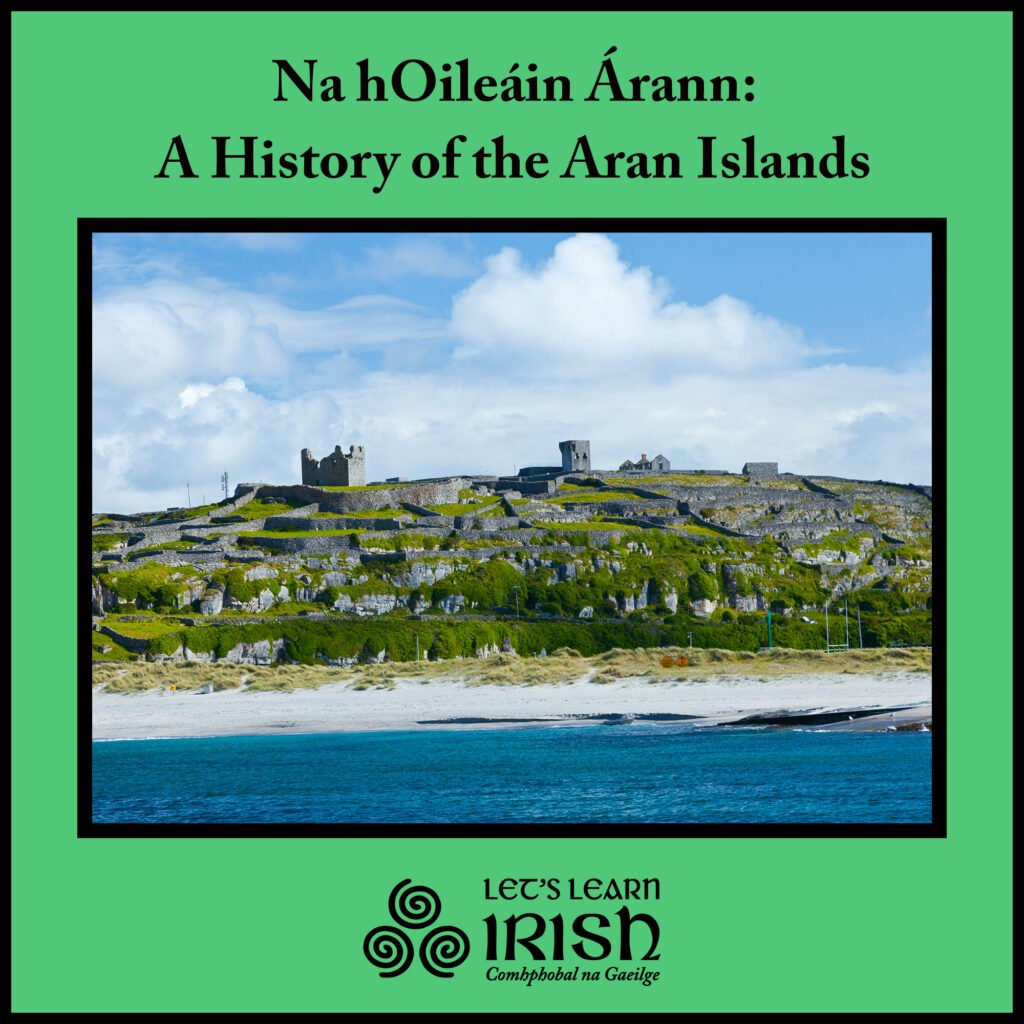
Na hOileáin Árann: A History of the Aran Islands

Finally, another part of the Aran Islands’ identity comes from being a Gaeltacht. Although Oliver Cromwell did arrive on the islands during his conquest of Ireland in the mid-17th century and set up a defensive fort there, he eventually left with his troops. The population of the islands increased afterwards, as some people from the mainland moved to the Aran Islands to escape the reach of the English. Because inhabitants were ultimately less harried by the colonizers, the Irish language was able to persist. Today, Irish remains the first language of the islands.

You Won’t Become Fluent in Irish With Duolingo

Despite its popularity, Duolingo has notable limitations compared with live online instruction. Technology can open access and build foundational skills for Irish learners, but it cannot replace the socially-embedded interaction of successful language learning. Recent research strongly suggests that Duolingo is most effective as a supporting tool rather than a standalone solution. App-based learning cannot provide the corrective feedback and sociolinguistic engagement of class instruction, conversation sessions, workshops or book club meetings.